
By Daniel Sheehan
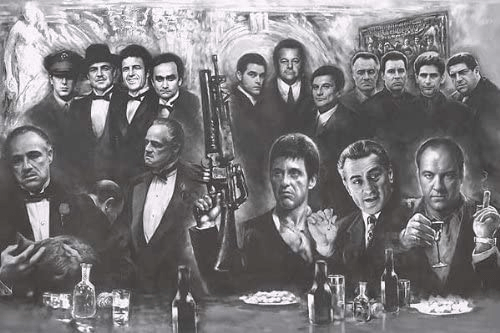
The Mafia is a criminal organization that began in Sicily in the 1800s, with its roots being found earlier in history through Sicily’s feudal system. Eventually, the Mafia would see a rise in America as the prohibition of alcohol created a large black market in the 20s, and as many Mafiosi fled to America during fascism in Italy. In both countries, the Mafia and organized crime became a major phenomenon in cinema. This begs the question: how does each country represent the heads of Mafia organizations?
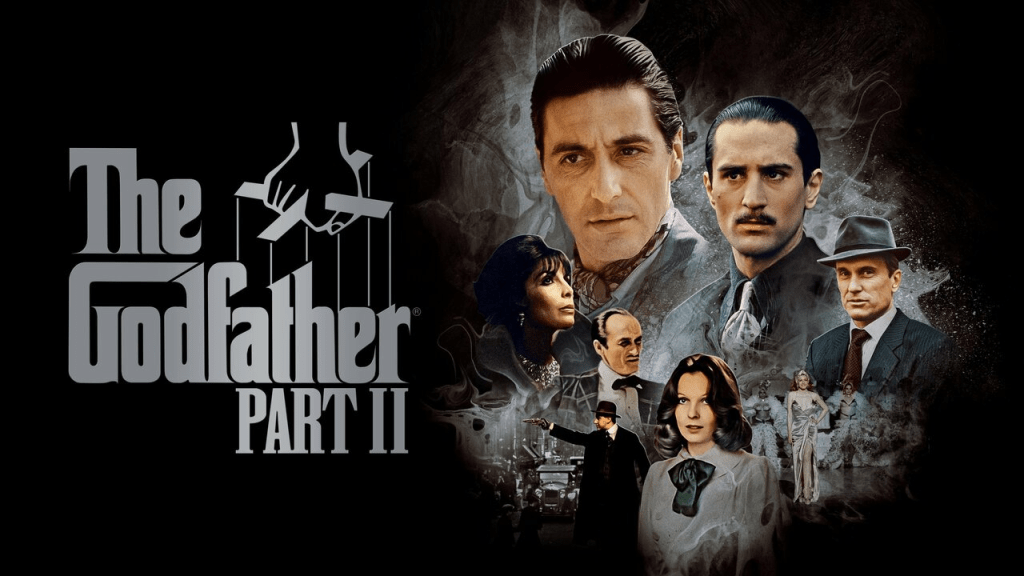
The Godfather, Part II is regarded as one of the greatest films of all time and one of the greatest Mafia films of all time. It follows Michael Corleone (Al Pacino), the head of the Corleone crime family, as he figures out who in his family betrayed him after an assassination attempt and as he continues to expand his criminal empire. The movie also follows a young Vito Corleone (Robert De Niro). It catalogs his rise to power, from immigrating to America as a child after the Mafia kills his family, his eventual rise as the head of the Corleone family, to his revenge on the Mafia boss who killed his family all those years ago.
Despite having ordered several murders, Michael Corleone is shown to be a shrewd businessman rather than a cold-blooded killer. Vito Corleone is depicted as an executor of justice and someone who always looks out for the less fortunate. His depiction as an executor of justice is shown by his killing of Don Fanucci, a Mafia boss who was shown to be greedy and abusing his power. After this, Vito assumes Fanucci’s role as the “police for Italians”. Vito is also shown to be looking out for the less fortunate. This is demonstrated through him preventing the old widow from being evicted. The film also depicts both heads of the family as family-oriented, demonstrated through Vito’s iconic line in the first film (“Because a man who doesn’t spend time with his family can never be a real man.”). They are also depicted as living lavish lifestyles, shown through Michael’s massive complex on Lake Tahoe in Nevada.
The Godfather, Part II heavily romanticizes the American Mafia. Even though both heads of the family are directly responsible for several murders, they are never represented through that lens. Instead, they are shown as intelligent, powerful businessmen who live opulent lifestyles and are dedicated to their families.

Goodfellas follows the rise and fall of mobster Henry Hill (Ray Liotta), who was involved in the largest heist in American history (the Lufthansa Heist, 5.875 million dollars stolen). Even though Henry is depicted as greedy and one of his associates, Tommy DeVito (Joe Pesci), is depicted as a bloodthirsty psychopath, the mob leadership is still depicted in a favorable light. Hill’s older associate, James Conway (Robert De Niro), who planned the heist, was depicted as generous. He is even shown slipping hundred-dollar bills into the wallets of the people he was robbing. The actual head of the Mafia, Paul Cicero (Paul Sorvino), is depicted as wise, powerful, protective of his crew, acting as a sort of mediator, and again, as a family man. He tries to make sure Hill quits selling drugs to keep both of them from getting caught again. He also becomes a business partner in a restaurant to protect the owner from the explosive Tommy DeVito.
Overall, the heads of the Mafia are depicted in a positive light in American cinema. In early Hollywood, though, gangsters were depicted in a negative light because of Xenophobia against a large wave of immigrants. People in Hollywood wanted to depict these new immigrants (in this case, Italians) as a threat to America (Gadarphe 12). However, as time went on, Italians in America began to use Mafia and gangsters as a way to “portray their own stories of being Italians in the United States” (Gadarphe 12). Additionally, outlaws being portrayed as protagonists has always been a common trope in American films (for example, Westerns starring an outlaw on the run from the law), which lends itself well to films about the Mafia (Vecchio). Additionally, in the modern day, the Mafia in America feels very distant and the only experience most people have with it comes from movies and TV shows, which has contributed to modern representations becoming disconnected from the actions of the real organization.
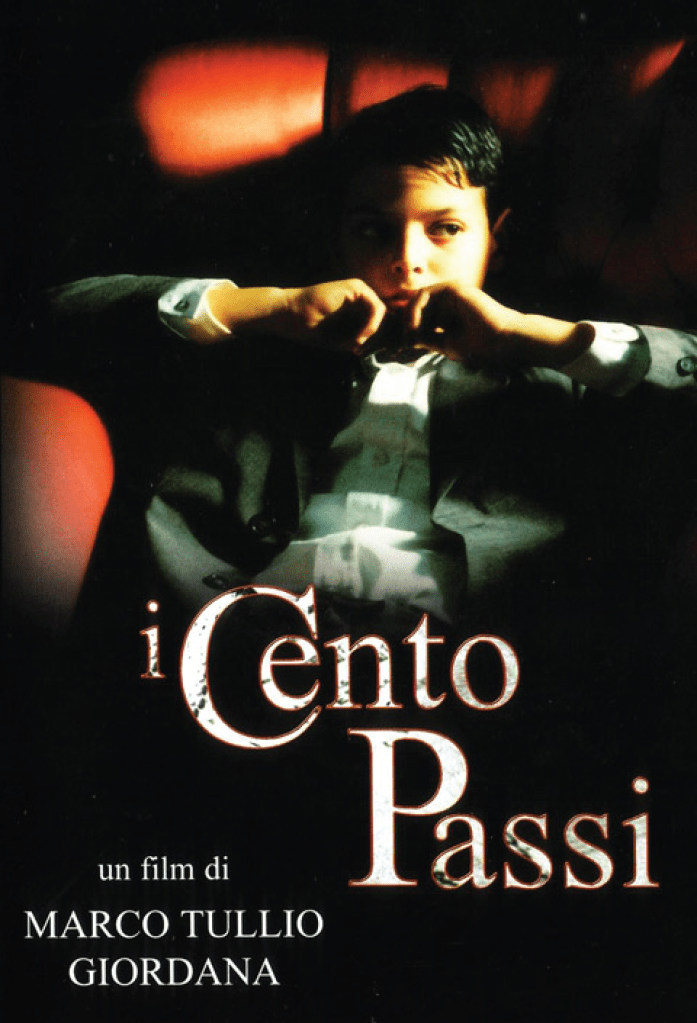
Italian movies usually depict the Mafia in a more sinister light, with more realistic depictions of the violence they cause. The film I Cento Passi (One Hundred Steps) is an example of this. It is a biopic about Giuseppe Impastato (Luigi Lo Cascio), an Italian communist and anti-mafia political activist from the town of Cinsi, Sicily. He first became involved with the anti-mafia movement after the death of his uncle, Mafia capo Cesare Manzella (Pippo Montalbano), and after speaking with activist and painter Stefano Venuti. Impastato started a radio station dedicated to mocking the Mafia, discussing communist ideas, and spreading awareness about the Mafia. The only reason Giuseppe is not killed immediately is because his father Luigi is a Mafioso. However, after coming back from a trip to America and speaking with his estranged son Giuseppe at a cafe, Luigi is struck by a car and dies. After that, Giuseppe was left with no protection. Mafia boss Tano Badalmenti had him beaten and tied to the train tracks with explosives. The Carabinieri and the local magistrate rule Giuseppe’s death as a suicide, despite the overwhelming evidence of his murder. The film ends with an anti-mafia march l down the streets of the Cinsi at Giuseppe’s funeral. In this film, the boss Badalmenti is depicted as power-hungry and egotistical. Badalmenti murders Manzella to gain power and to be able to build an airport. In the beginning sequence, Cesare allows Giuseppe to steer his car and jokingly tells him to run over Badalmenti. After that, you can see Badalmenti grow with rage at a simple joke. Badalmenti also has Giuseppe killed just for criticizing him and his organization.
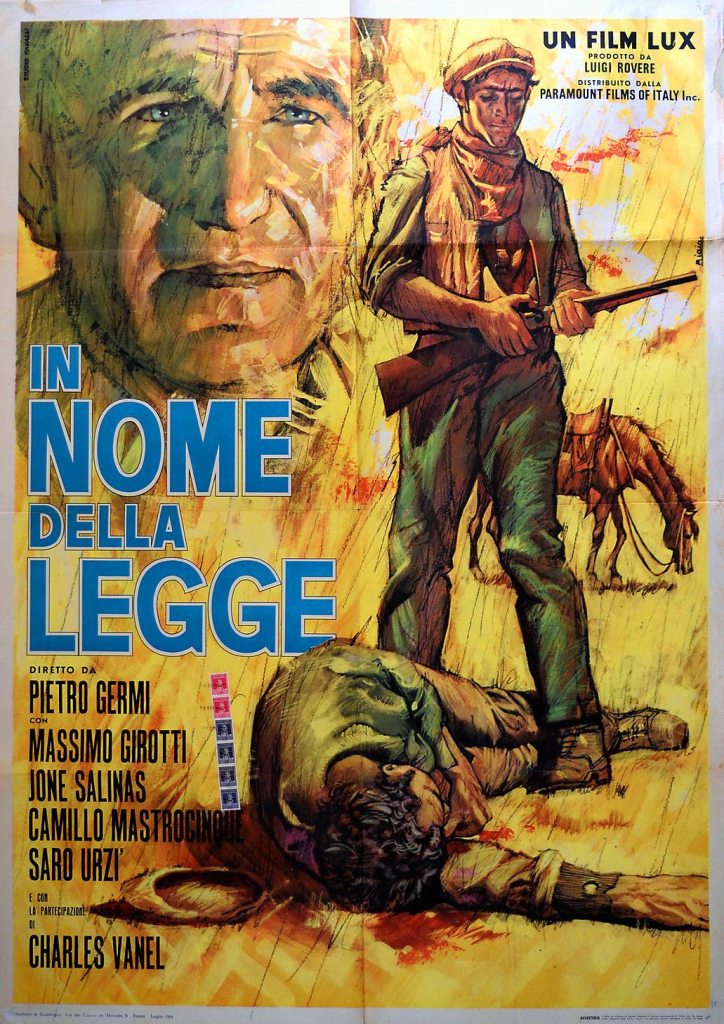
In Nome della Legge follows Judge Guido Schiavi (Massimo Girotti) as he tries to bring justice to a town ridden by Mafia. The Mafia has closed the town mine, the main source of income for many of the residents, and after attempting to get the town’s Mafia-controlled Baron (Camillo Mastrocinque) to open it, Guido has an altercation with the town’s Mafia boss, Massaro Turi Passalacqua (Charles Vanel) that leads to both Guido and the town Marshall (Saro Urzì) insulting the boss. This leads to a feud between the law as enacted by the Italian government (Guido and the Marshall) and the law as enacted by the Mafia. Eventually, the Mafia has Guido transferred away from the town following an assassination attempt. This movie depicts Passalacqua as egotistical and the enemy of the public. He has someone killed over an insult and aims to do the same to the Judge. Additionally, Passalacqua has decided to starve the entire town for his gain and threatened the Judge to try to keep it closed. Additionally, the Mafia as a whole in this movie is treated as the status quo, with both the Baron and Passalcqua calling it “an ancient Sicilian tradition”, in an attempt to alienate the Judge from the town’s culture (even though he is from Palermo).
Italy portrays the Mafia closer to what it actually is: a violent criminal organization. According to Alfio Leotta, the depiction of the Mafia had different stages in Italy. In the 1950s, Mafia movies were depicted like a typical western (Leotta 2). In Italy, Sicily was still seen as a lawless frontier, so many films (such as Il Nome della Legge) depict a judge or policemen coming to a corrupt Mafia town to clean it up, reflecting the classic outlaw trope in American cinema. In this case, the judge is ironically the outlaw and the Mafia is the law. The 1960s saw the Mafia become a backdrop for comedies as a way to mock it, while more serious films (such as The Day of the Owl) were created to bring awareness to it (Leotta 3). The 1980s and 1990s saw strongly anti-mafia movies as anti-mafia sentiment in the country grew stronger, in a movement called “cinema democratico” by some directors (Leotta 4). These films commonly depicted a hero, such as a judge or policeman, taking on the Mafia despite all odds being against them. More recently, Mafia movies in Italy have shifted from depicting people in power (judges and police officers) resisting the Mafia to ordinary citizens, such as Giuseppe in I Cento Passi (Leotta 5). Overall, movies about the Mafia in Italy depict the organization as the enemy, which aids in the depiction of the bosses and the mafioso as an evil, power-hungry killer.
Despite the organization existing in both countries, Italy and America depict the heads of the Mafia in opposite ways. American movies show Mafia bosses to be savvy businessmen, who are family-orientated and live opulent lifestyles, while Italian movies show the bosses to be egotistical, bloodthirsty, and power-hungry. Interestingly, the depiction of the Mafia in both countries is tied to both the strength and public perception of the organizations. In America, the Mafia operated more underground and was seen by the public as more of a fairytale rather than an actual criminal organization, while in Italy, the Mafia had permeated almost every aspect of life in Sicily and had infected Italian politics. The Mafia in Italy also committed more violent acts against any judge or policemen who resisted them. These two different worlds of Mafia led to American Mafia heads being depicted as more of a hero, while in Italy, the heads were portrayed as evil.
Works Cited:
Gardaphé, Fred. From wiseguys to wise men: The gangster and Italian American masculinities. Routledge, 2013.
The Godfather, Part II. Directed by Francis Coppola, Paramount Pictures, 1974.
Goodfellas. Directed by Martin Scorsese, Warner Bros. Pictures, 1990
I Cento Passi. Directed by Marco Tullio Giordana, Raro Video, 2000.
In Nome Della Legge. Directed by Pietro Germi, Lux, 1949.
Leotta, Alfio. “Do Not Underestimate the Consequences of Love: the Representation of the New Mafia in Contemporary Italian Cinema”. Italica, vol. 88, no. 2, 2011, pp. 286-296. https://www.jstor.org/stable/23070839
Vecchio, Michael. “The Mafia, The Godfather, and Hollywood Romance”. History Guild, 2022. https://historyguild.org/the-mafia-the-godfather-and-the-hollywood-romance/

 Italian Culture